The story comes first
These are real stories, not lessons in disguise. The language simply comes along for the ride.

Short stories · Language learning
Fluency Weave makes original short-story collections that teach a language as you read them. New words arrive in sentences you already understand, then keep coming back until they’re yours. Just turn the page, and the language grows with you.
Every , Nora opens the window. Her is waiting.
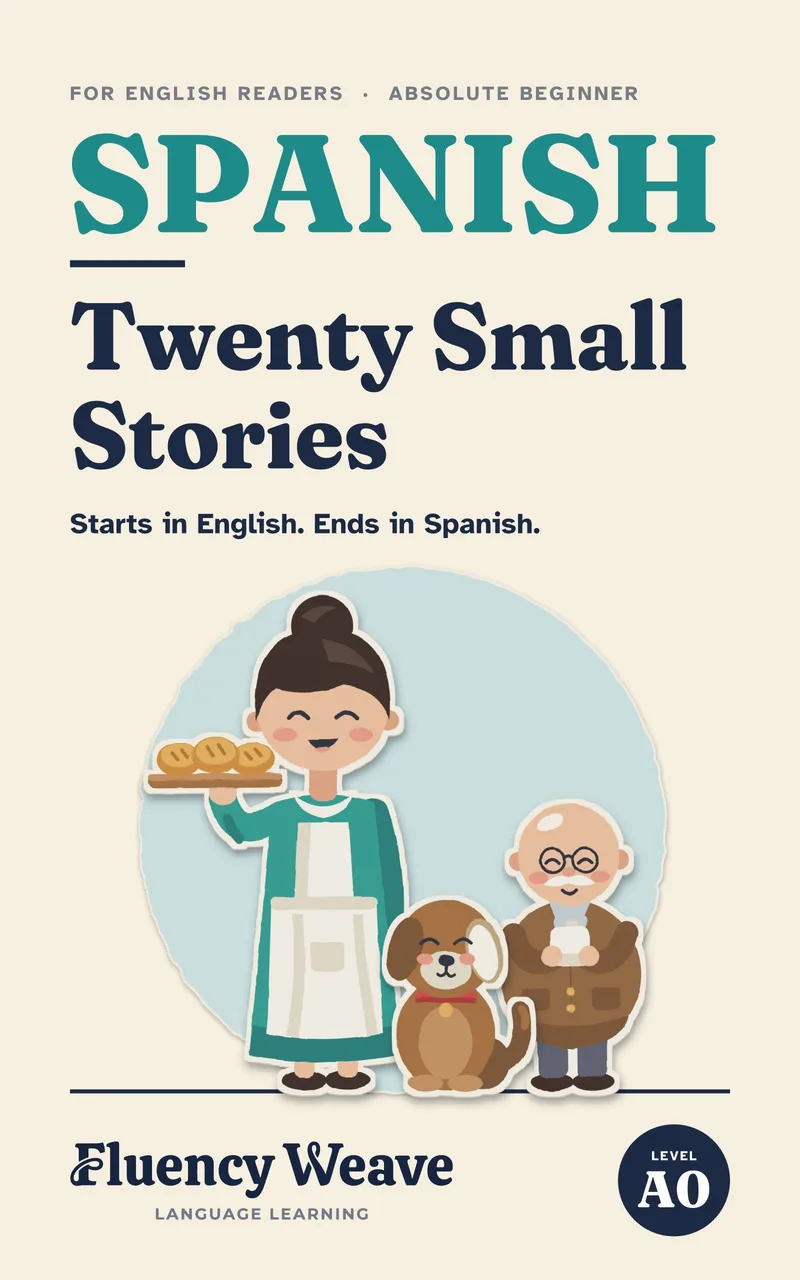
Try a page
The page below is an example. It shows moments from four different stories in one book, Spanish for English readers. Every story is new, but the words you learn keep coming back. By the last one you're reading it all in Spanish, and it doesn't feel like a leap. Every language we add works the same way.
Every , Nora opens the window. Her , Miga, sits in the sun.
“, Miga,” says Nora.
The looks at the street and says nothing. He is waiting for something.
Nora and her cat. Mostly English, with a few Spanish words woven in. Each one is new.
How it works
Most language apps drill words. Fluency Weave gives you a good story, and lets the language ride along.
These are real stories, not lessons in disguise. The language simply comes along for the ride.
You start in English with a few new words sprinkled in. Story by story, more of the page switches over. The last story is told entirely in the new language, with no help, using only words the earlier stories taught.
The everyday words come back story after story. A word you’ve met only a few times gets its meaning once more when it returns after a few stories away. After that, the glossary is your safety net.
About 15 new words a story at A0, in short sentences: eight words at most in the new language. You’ll always understand enough to keep reading.
A note explains the word as it appears on the page, then gives its dictionary form: mira — looks · from mirar: to look
Pronunciation
Pronunciation never interrupts the story. You get a little help up front, a hint the first time you meet a word, and then the page is yours.
Every book opens with a one-page guide to how the language sounds: the few rules that let you sound out most words yourself, plus the sounds English doesn’t have.
After that, every new word gets its sound once, in its note, the first time you meet it. The stressed syllable is in capitals.
sombra (SOHM-brah) — shadow
A new word gets a small numbered note: a footnote at the bottom of the page in print, a tap in the ebook. It gives the word, how it’s said, and what it means, once. Everything is also in the glossary at the back.
Why it works
Fluency Weave isn't a gimmick. Every part of the design follows decades of research on how people learn new words, and the books do the planning so you don't have to.
You meet it in bold, inside an English sentence you already follow.
It shows up in a brand-new story, without the bold. Now you remember it yourself.
It shows up surrounded by Spanish, and you still know it.
You read right past it. It’s just a word you know.
The research
People pick up new words from context while they read. It works when the reader can follow the text, and that takes knowing roughly 98% of the words on the page.
Nagy, Herman & Anderson, 1985 · Hu & Nation, 2000
In every book
Every new word lands in a sentence you can already read, so you can work out what it means the first time you meet it.
The research
One meeting isn’t enough. Words seen only a few times while reading are mostly forgotten within months, and it can take around ten meetings for a word to really stick. Spreading those meetings out works better than cramming them.
Waring & Takaki, 2003 · Webb, 2007 · Cepeda et al., 2006
In every book
The everyday words come back across later stories, in new sentences and new situations, spaced out the way memory likes.
The research
Pulling something out of memory strengthens it far more than looking at it again. It’s one of the most reliable findings in learning science.
Roediger & Karpicke, 2006
In every book
Once you’ve met a word, it returns without the bold. Each time, you recall it on your own, with the glossary as a safety net if you need it.
The research
Words you have to think about, and actually need, are remembered better than words you just glance at on a list.
Craik & Lockhart, 1972 · Laufer & Hulstijn, 2001
In every book
You figure out each word because you want to know what happens next. The story gives you a reason to care what gato means.
Straight talk: nobody has run a big formal trial on this exact style of book yet. Only small classroom studies exist. What we can say is that each piece of it rests on findings that have held up again and again.
The stories
Each book is a collection of short stories. Read one on the bus, read three before bed. Only the language carries forward.
Find your level
From total beginner (A0) to advanced (C2). Each book is written for one level and stands alone.
Each story fits a coffee break and stands on its own. Only the language carries forward.
One hero, one clear goal, a few people and places. Easy to follow, even in a new language.
Ordinary life with a little charm, fun and mystery in it: a baker whose bread keeps going missing, a postman with a letter nobody will claim, a very odd Tuesday.
Every town and city is made up, so nothing gets in the way of the story.
Library
Spanish comes first, on Kindle and paperback. Plenty more is on the way.
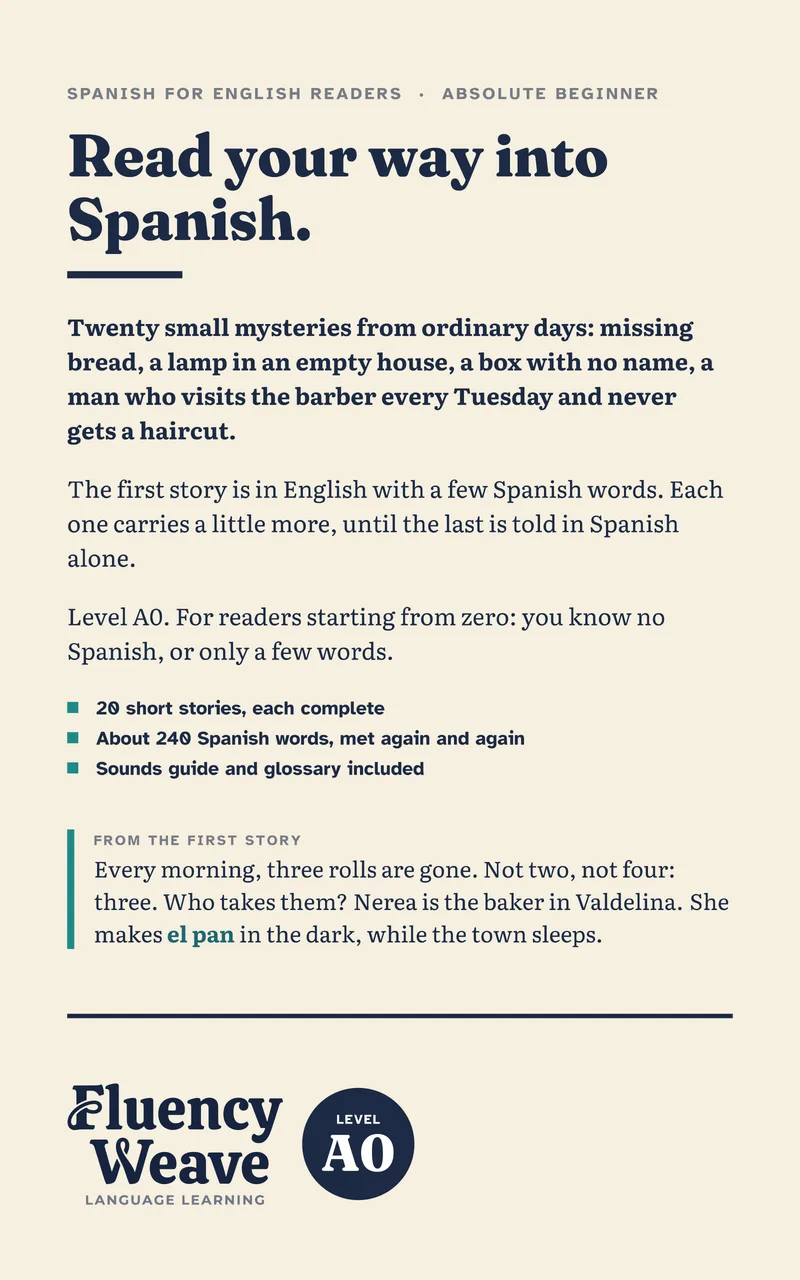
Twenty small everyday mysteries: missing bread rolls, a lamp in an empty house, a man who visits the barber every Tuesday and never gets a haircut.
New collections and new languages are on the way.
What's next
Spanish is just the start. Italian, Portuguese and French are in preparation, and they’ll be added book by book.
Collections for total beginners first, then on up through intermediate and advanced, all the way to C2.
We’re exploring a Fluency Weave app, so the stories can come with you on your phone. It’s early days, and we’ll share more as it takes shape.
Made with care
The pace, the words and the stories are all planned, so learning feels like reading and not like homework.
Every book is mapped out before it’s written, so new words arrive at a gentle, steady pace.
Every story’s language is reviewed for correctness and naturalness, and a fluent speaker reviews each book before release.
An honest note: these books are a great companion to a class, an app or a tutor. They aren't meant to replace one.
No flashcards, no drills. Just a good book that leaves you knowing more of a new language than when you opened it. First up is Twenty Small Stories, Spanish for complete beginners, coming soon to Kindle and paperback.
Coming soon